

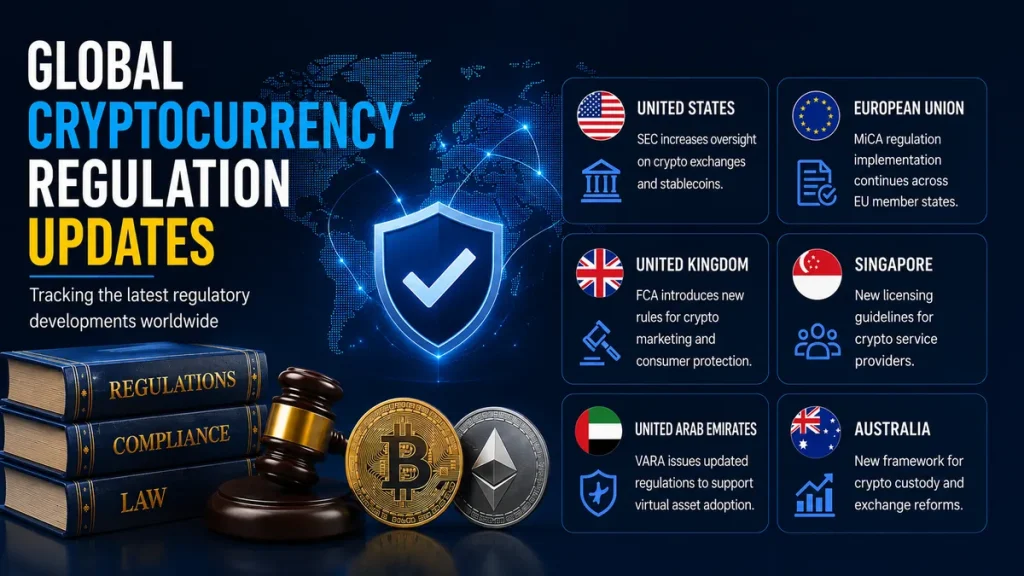
Global regulators are updating crypto rules to clarify duties, improve protections, and set clearer paths for disclosure. The trend favors transparency and cross-border cooperation.
Global cryptocurrency regulation updates: current landscape, reforms, and enforcement trends
Regulators publish guidance to clarify token status, licensing, and AML rules, with growing but uneven global alignment. global crypto laws
Regional deep dives: United States, European Union, United Kingdom, and Asia-Pacific policy shifts
In the United States, EU, UK, and Asia-Pacific, policy shifts push registered offerings, disclosures, and sandbox testing. Regulation News
Practical guidance for exchanges, token issuers, and investors: compliance, reporting, and risk management
Exchanges should pursue licensing, issuers must disclose risk and details, and investors should verify regulatory status and issuer integrity.
Global trends: innovation, sandbox programs, and cross-border cooperation
Regulators expand sandboxes, share insights, and coordinate to supervise cross-border crypto activity while encouraging safe innovation.
Risk management and compliance best practices in 2026
Adopt a risk-based framework, keep governance tight, and stay aligned with evolving guidance and reporting requirements.
Frequently asked questions
- What is the goal of current crypto regulation? A: To improve investor protection and market clarity.
- How can exchanges stay compliant across regions? A: Seek licensed status, implement consistent KYC/AML, and monitor updates.
- What should investors watch in new rules? A: Licensing status, disclosures, and risk warnings.
Conclusion: The regulatory landscape continues to evolve, balancing innovation with safeguards and consumer protections.