

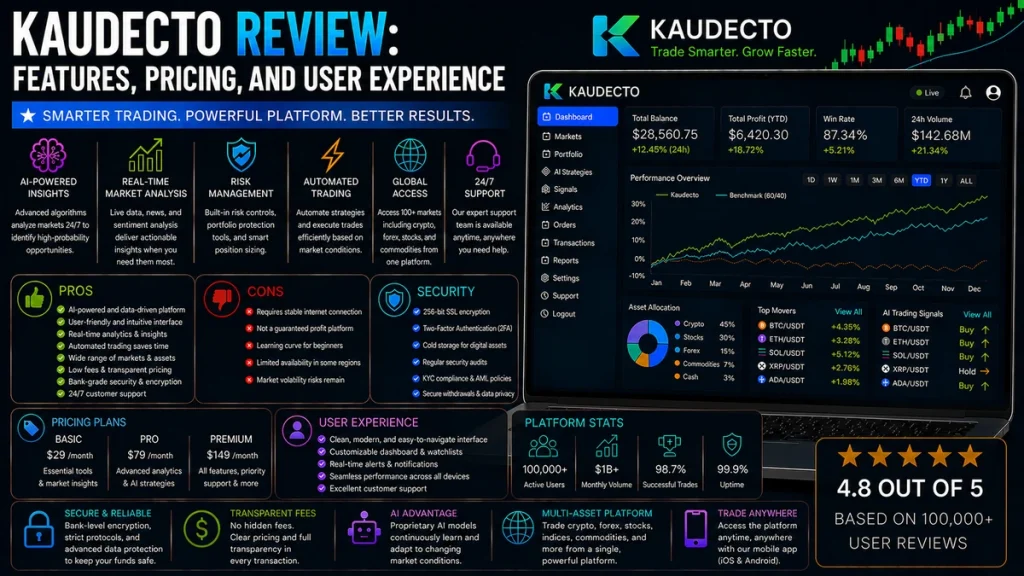
Kaudecto is an AI-driven trading platform aimed at retail and semi-professional traders seeking automated strategies and analytics. This review covers core features, pricing, usability, security, and real user feedback to help decide if it fits your trading style.
Key features
- AI trading algorithms: Multiple models generate signals and execute trades automatically.
- Strategy library: Prebuilt strategies that users can deploy or customize.
- Backtesting: Historical simulation tools to evaluate performance and refine parameters.
- Risk management: Position sizing, stop-loss, and portfolio-level limits.
Pricing tiers, free trial, and subscription details
Kaudecto typically offers tiered subscriptions (basic, pro, institutional) with differing strategy access and execution limits. A free trial or demo mode is often available to test features before subscribing. Check the platform for current plans and billing cycles.
Ease of use
Onboarding is designed to be straightforward with guided setup, strategy templates, and a modern dashboard. Mobile app availability may vary by region; Kaudecto provides responsive web access and native apps where supported.
Security, regulation status, and data privacy
Kaudecto emphasizes data encryption, API key security, and account protections. Users should verify regulation status and data handling policies in their jurisdiction before funding accounts.
Pros and cons
- Pros: Automated strategies, robust backtesting, and risk controls.
- Cons: Potential learning curve for customization and reliance on model assumptions.
Real user reviews and common feedback
Users often praise the ease of deploying strategies and the depth of backtesting. Common critiques include subscription costs and occasional mismatches between backtest and live performance.
Final verdict and recommendations
Kaudecto suits traders who want a balance of automation and customization. Beginners benefit from templates; experienced quants can refine models. Conservative users should start small and test extensively.
AI Trading Platform Overview: Technology, Benefits, and Risks
AI trading platforms apply machine learning to market data to generate signals, optimize portfolios, and automate execution. Models range from statistical learning to deep learning and reinforcement learning.
How they work and top use cases
- Signal generation via pattern recognition and feature engineering.
- Automated trading and execution for speed and discipline.
- Portfolio optimization and algorithmic strategies for diversification.
Comparison criteria
When evaluating platforms consider accuracy, latency, available integrations, customization level, and customer support. For a broader perspective on providers, consult an AI trading platform resource.
Benefits
- Efficiency and 24/7 monitoring
- Reduced emotional trading decisions
- Scalable strategy deployment
Risks and limitations
- Model overfitting and data bias
- Vulnerability in new market regimes
- Operational risks like connectivity and latency
How to evaluate and best practices
- Use realistic backtests and walk-forward validation.
- Start small and apply strict risk controls.
- Monitor models continuously and diversify strategies.
FAQ
- Is Kaudecto suitable for beginners?
- Yes, with templates and demo modes, but start with small allocations.
- Can AI platforms guarantee profits?
- No—AI can improve decision-making but cannot eliminate market risk.
- How do I secure API keys?
- Use least-privilege keys, enable two-factor authentication, and store credentials securely.
Conclusion
Kaudecto offers a robust mix of AI tools, backtesting, and risk management suitable for various trader types. Pair it with prudent evaluation and conservative position sizing. For broader comparisons and platform options, see an AI trading platform guide.