

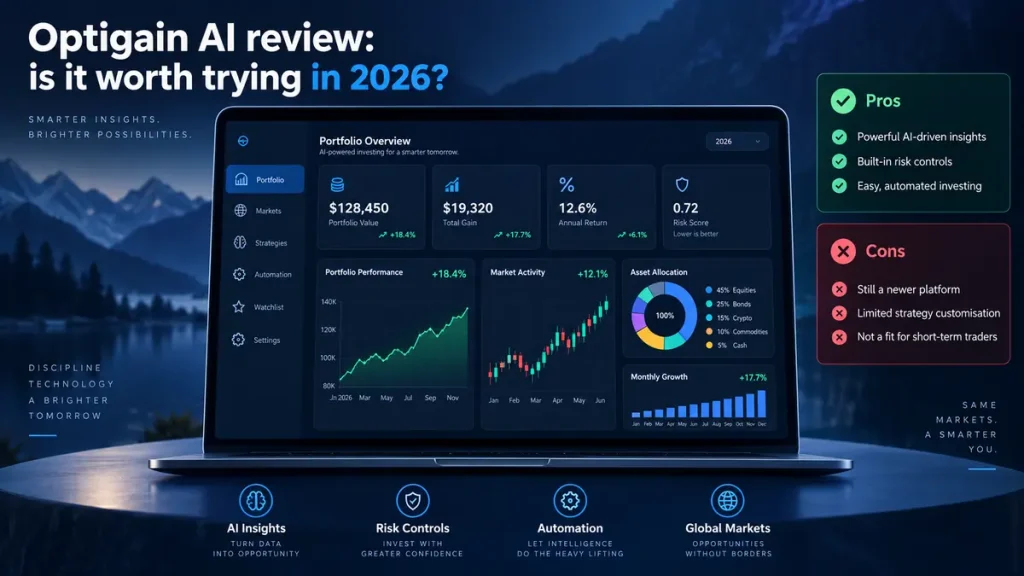
This concise review examines Optigain AI and whether it deserves attention in 2026. We cover core features, pricing, integrations, real-world performance signals, pros and cons, and a practical trial checklist to help teams decide quickly.
Optigain AI overview and key features
What Optigain AI is and who it’s for
Optigain AI is a marketing and conversion intelligence platform aimed at SMBs and mid-market teams focused on demand gen, personalization, and automation.
Core capabilities
- Lead generation: predictive scoring and intent models.
- Conversion optimization: automated A/B and multivariate testing.
- Personalization: dynamic content and segment-based journeys.
- Analytics: dashboards, attribution, and cohort analysis.
Pricing tiers and value comparison
Optigain AI offers tiered plans with a free trial and usage-based enterprise options. In 2026 updates include modular add-ons for advanced forecasting. Compare tiers by included API calls, seat limits, and SLA.
Integration and technical requirements
- Works with major CRM and CMS platforms; check supported adapters for your stack.
- APIs support event streaming and webhooks; engineering time varies by integration depth.
- Data privacy: review data residency and processing terms before onboarding.
Is Optigain AI worth trying in 2026?
Performance and ROI evidence
Look for case studies and track metrics like lead velocity, conversion lift, CAC changes, and time-to-insight during a pilot.
Pros and cons
- Pros: strong personalization, flexible testing, evolving feature set.
- Cons: requires data maturity, potential integration effort, competitive market alternatives.
Ideal use cases and who should avoid it
- Ideal: B2B growth teams, ecommerce sites with variable catalog, marketers with analytics resources.
- Avoid if: you lack clean first-party data or have minimal engineering bandwidth for integrations.
Trial checklist
- Define success metrics (conversion lift, MQLs, revenue per campaign).
- Run a 4–8 week pilot integrating with CRM and analytics.
- Test lead scoring, personalization flow, and API reliability.
- Ask about support SLAs, data handling, and upgrade paths.
For platform details and sign-up options, see Optigain AI and explore integrations with an AI trading platform provider if you need broader automation.
FAQ
- How long is a typical pilot? — 4–8 weeks to gather meaningful metrics.
- Does it require a data warehouse? — Recommended for best results but not mandatory.
- Is it suitable for small teams? — Yes with basic plans, but advanced features need more resources.
Conclusion: Optigain AI is worth testing in 2026 if you have first-party data and clear KPIs. Use a short, instrumented pilot to validate ROI before committing to higher tiers.