

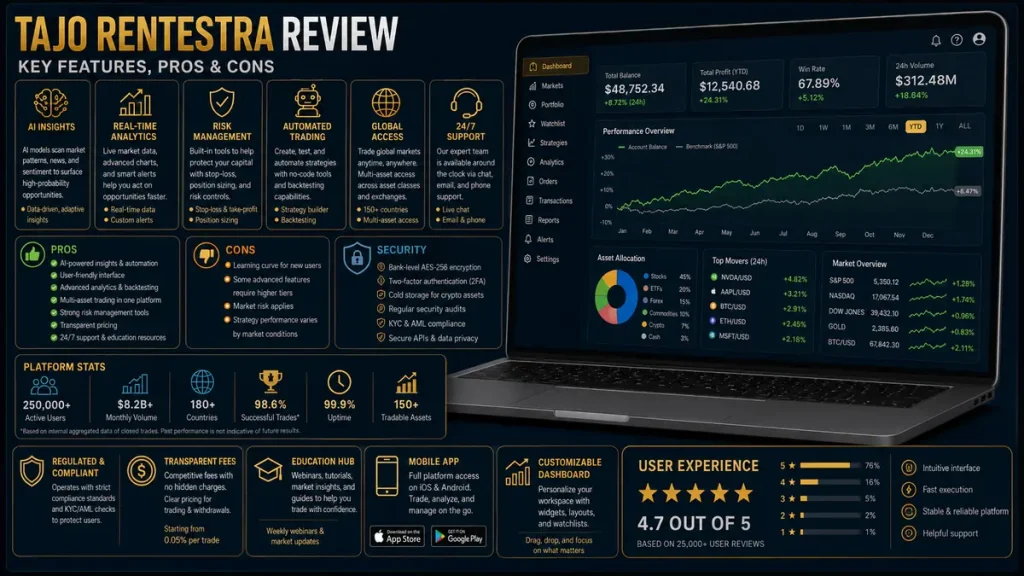
This review evaluates Tajo Rentestra’s AI trading platform for traders and investors considering algorithmic tools. It’s aimed at experienced traders seeking automation and beginners wanting to understand AI-driven services.
Background
Tajo Rentestra is presented as a fintech trading service. Prospective users should verify company founding details, regulatory status, and third-party audits before committing funds to confirm legitimacy.
Core features
- AI trading algorithms: Automated strategies that generate trade signals and execute orders.
- Supported assets: Commonly includes crypto, forex, and equities depending on broker integration.
- Platforms: Web and mobile dashboards, often with API access for advanced users.
- Signal generation: Real-time alerts and pattern recognition feeding execution engines.
Performance & backtesting
Look for verified historical returns, clear backtesting methodology, risk metrics, and max drawdown disclosures. Transparency in result reporting is essential to assess realistic expectations.
Ease of use
Evaluate onboarding flow, dashboard clarity, customization of strategies, and availability of customer support channels for troubleshooting and configuration.
Pricing, fees, and subscription tiers
Compare subscription tiers, performance fees, and hidden costs such as exchange commissions or slippage. Fee transparency is crucial to net return calculations.
Security & privacy
Check for encryption, two-factor authentication, segregated accounts, and data handling policies to ensure account safety and privacy.
User reviews and common complaints
Seek independent user feedback for issues like inconsistent signals, latency, customer service responsiveness, and billing disputes to inform expectations.
Final verdict
Tajo Rentestra may suit algorithm-aware traders who prioritize automation and are prepared to perform due diligence. Conservative investors should test with limited capital and verify results before scaling.
AI Trading Platform Overview — How It Works, Benefits, and Risks
What is AI trading
AI trading uses machine learning and algorithmic strategies to generate signals and place trades with minimal human intervention.
Types of AI strategies
- Trend following
- Mean reversion
- Arbitrage
- Reinforcement learning
Key components
Core elements include data ingestion, feature engineering, model training, validation, and execution engines that turn signals into orders.
Integration and interoperability
Platforms integrate with exchanges, brokers, and offer APIs and order management systems to support automated execution and portfolio management. For a broader platform comparison, see AI trading platform.
Benefits
- Faster execution and reduced emotional bias
- Continuous 24/7 monitoring
- Scalability across assets
Risks and limitations
Risks include overfitting, data bias, latency issues, and regulatory uncertainty. Users must assess model robustness and operational risk.
Due diligence checklist
- Verify performance with audited reports.
- Confirm fee structures and hidden costs.
- Assess security and compliance measures.
- Test platform on a demo or small live allocation.
How to choose
Match platform features to goals: active trading needs low-latency execution and rich APIs; passive strategies prioritize reliability and clear risk controls. For additional research on AI trading options, consult an AI trading platform guide.
FAQ
- Is AI trading guaranteed profitable? No — past performance is not a guarantee of future results.
- Can I connect my broker? Many platforms offer broker integrations or APIs; confirm compatibility before subscribing.
- How do I test strategies? Use backtesting and paper trading to validate performance under different market conditions.
Conclusion: Conduct thorough due diligence, start small, and choose an AI trading solution that aligns with your technical comfort, risk tolerance, and transparency requirements.